
By Ron Lang, CEO, CalCPA Health (June 2026 issue of CalBroker Magazine)
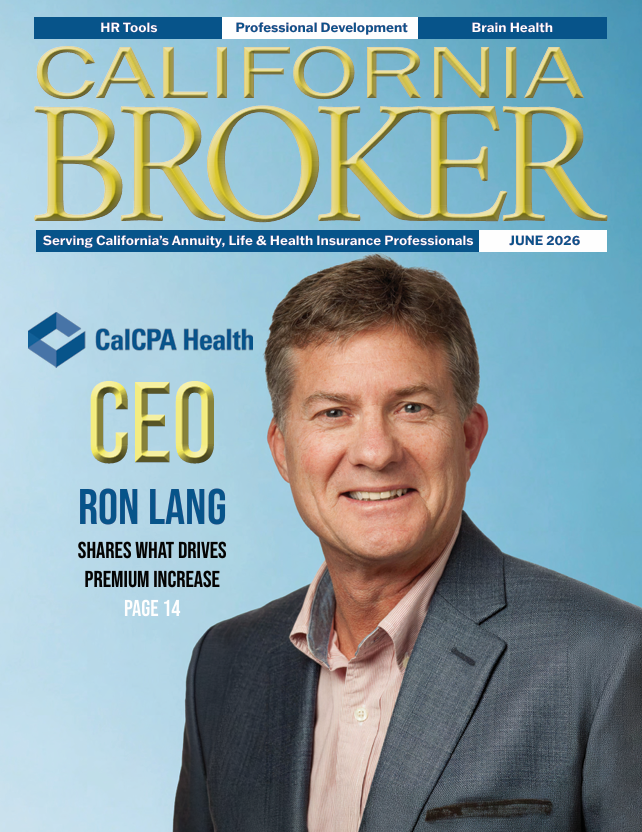 Over the past 18 months, health insurance premiums have risen at levels not seen since the early days of the Affordable Care Act (ACA). For consumers, the conclusion feels obvious: insurance companies must be driving up premiums.
But that conclusion overlooks how the system actually works.
Consumers, and often the media, see only the end result: higher premiums. Meanwhile, hospitals, physicians, and pharmaceutical manufacturers largely escape the same level of scrutiny. Health insurers, for their part, have not always been effective at communicating their role in managing these costs.
The reality is that today’s premium increases are the result of multiple factors converging at once, each pushing the total cost of care higher.
Why Premiums Are Rising Faster Now
High-Cost (“Nuclear”) Claims
Extremely expensive cases are reshaping the total cost curve. Gene therapies can exceed $2 million for a single treatment, and other breakthrough treatments come with million-dollar price tags. These innovations miraculously improve patients’ lives, but their costs ultimately flow through to premiums.
Prescription Drug Spending
Drug costs continue to outpace overall medical inflation. More individuals are taking medications for more conditions, and specialty drugs, particularly in oncology and rare diseases, carry annual costs in the hundreds of thousands of dollars.
GLP-1 medications, used for diabetes and weight management, are a prime example: high utilization combined with high cost is materially impacting trend.
A decade ago, prescription drugs accounted for less than 10% of total healthcare spending. Today, that figure has doubled to around 20%, a shift driven not by traditional inflation, but by the rise of specialty therapies and high-cost chronic treatments. Prescription drugs, while still a minority of total spend, are now one of the fastest-growing components of overall healthcare costs.
While generics and biosimilars continue to provide savings in some categories, those gains are frequently offset by the introduction of newer, higher-cost therapies. GLP-1 utilization is further accelerating this trend.
Increased Utilization Across the Board
People are simply using more healthcare. Rising rates of obesity, diabetes, cardiovascular disease, and autoimmune conditions are driving more physician visits, diagnostic testing, hospitalizations, and prescriptions. When utilization increases, total costs, and therefore premiums, follow.
Wage and Price Pressures in Healthcare
Healthcare is labor-intensive. Hospitals and physician groups are facing sustained wage pressure for nurses, physicians, and skilled technicians. Many provider contracts renew on multi-year cycles, meaning recent inflation is only now being reflected in negotiated reimbursement rates.
The “Regulatory Stack”
New state and federal mandates, while often well-intentioned, add incremental cost. Recent examples in California include expanded IVF coverage requirements and caps on insulin cost-sharing. Each mandate adds to what some refer to as the “regulatory stack,” while each mandate may be a small percentage increase to premiums, together and over time, they add a material amount. Meanwhile, legislation that would actually reduce costs, rarely seems to be enacted.
Why Health Insurance Companies Look the Way They Do
Consumers and employers wanting the lowest possible premiums have shaped what health insurers look like. Many of the features consumers associate with “insurance friction” were originally designed by health insurance companies to control doctor/hospital behavior and costs; and protect patients from unnecessary or overpriced care.
These include:
- Prior authorization and utilization review
- Second surgical opinions
- Provider networks that negotiate discounted rates
- Case management and billing oversight
- Preferred Provider Networks (and HMO’s)
Care delivered outside of PPO/HMO networks typically lacks these cost and safety controls, which is why out-of-network services are often significantly more expensive.
On the pharmacy side, Pharmacy Benefit Managers (PBMs) deploy tools such as formularies, generic substitution, step therapy, and manufacturer rebates to slow the growth of drug spending. These mechanisms are often criticized, but without them, costs would be significantly higher.
Built-In Limits on Insurance Company Profits
It is also important to understand that health insurers operate under explicit profit constraints. Under federal law (ACA), medical loss ratio (MLR) requirements leave a set percentage (15 or 20%) for insurance carrier expenses, including profit. Failure to meet MLR thresholds results in premium rebates, thereby limiting carrier profits. This structure effectively caps margins and ties insurer profitability to overall healthcare spending. When costs rise, premiums must follow, not to increase profits, but to cover claims.
Bottom Line
Health insurers are often the most visible part of the system, but they are not the primary drivers of cost increases. In many ways, they function as financial intermediaries, aggregating and managing the underlying costs generated elsewhere in the healthcare system.
California’s Health Care Affordability Council was chartered to cap premiums and healthcare spending, but to date, has had little measurable effect on overall costs. If the goal is to meaningfully address rising premiums, the focus must be on the drivers of healthcare cost: provider/hospital costs, pharmaceutical pricing, and regulatory design.